
Design Assurance Levels (DAL) in DO-254
Understanding DAL A Through DAL E for Airborne Electronic Hardware
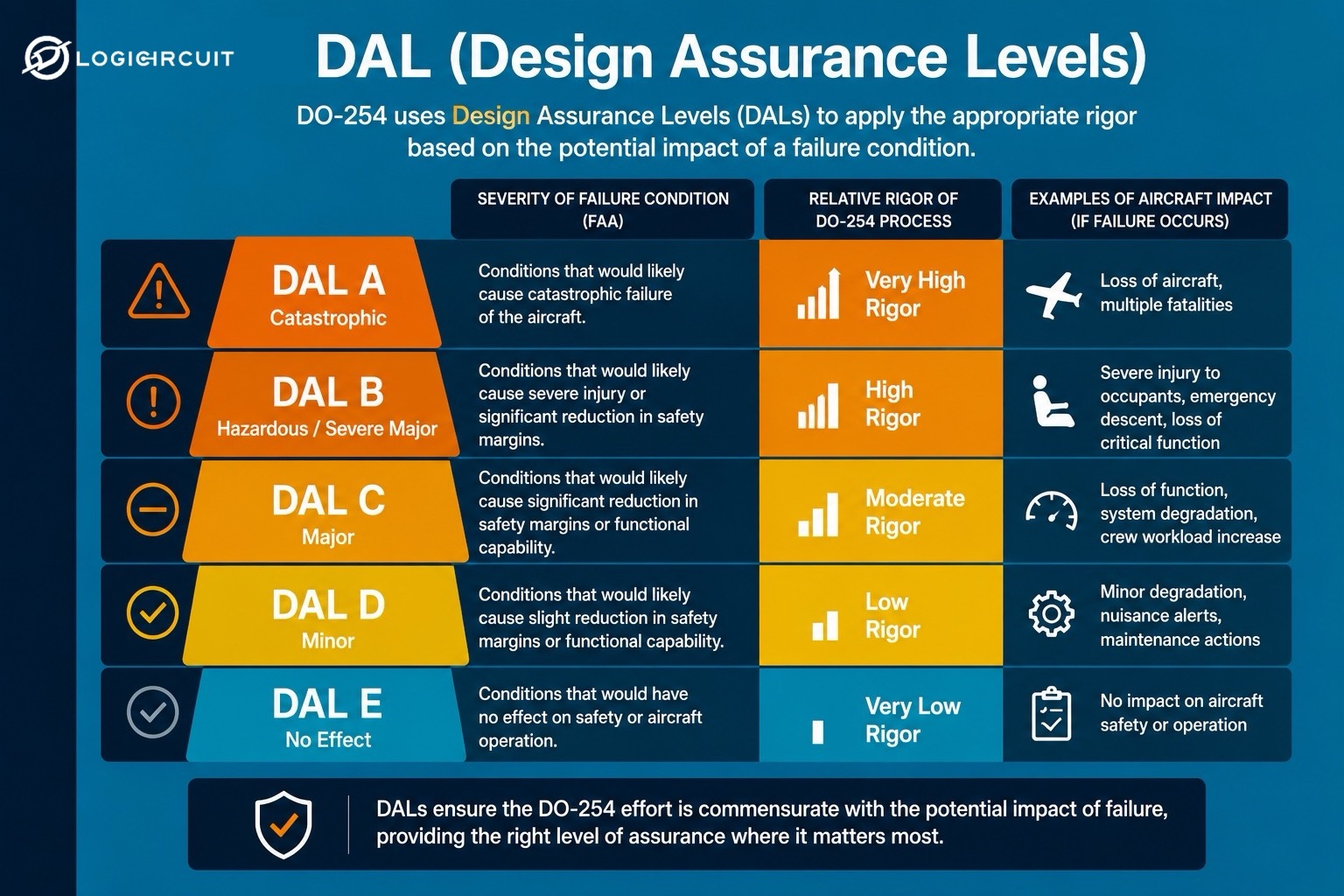
Design Assurance Levels (DALs) are one of the foundational concepts within DO-254 certification. They define the level of rigor required during the development and verification of airborne electronic hardware based on the potential effect a hardware failure could have on aircraft safety.
For FPGA-based avionics and airborne systems, the assigned DAL directly affects:
- Verification rigor
- Traceability expectations
- Review independence
- Configuration management
- Certification evidence
- Coverage analysis
- Process assurance activities
- Audit expectations
Understanding DAL classification is critical for aerospace and defense companies developing certifiable airborne electronic hardware.
What Is a Design Assurance Level (DAL)?
A Design Assurance Level is a classification assigned to airborne systems, software, or hardware according to the severity of failure conditions that could result from malfunction or incorrect behavior.
In DO-254, DALs range from:
- DAL A (most critical)
to - DAL E (least critical)
The higher the DAL, the greater the certification rigor required.
DALs are derived from system safety assessments performed at the aircraft or system level. Hardware developers typically receive the assigned DAL as part of the system requirements and certification basis.
The Five DO-254 Design Assurance Levels
DAL A — Catastrophic Failure Condition
DAL A represents the highest level of certification rigor.
A hardware failure condition classified as catastrophic could contribute to:
- loss of aircraft
- loss of life
- inability to continue safe flight and landing
DAL A airborne electronic hardware requires the most stringent DO-254 objectives, including:
- extensive verification
- high traceability rigor
- strong configuration management
- verification independence
- comprehensive certification evidence
- detailed review activities
- robust process assurance
DAL A FPGA systems are common in:
- flight control systems
- critical display systems
- flight management systems
- engine control systems
- safety-critical processing systems
DAL B — Hazardous / Severe-Major Failure Condition
DAL B hardware failures could contribute to hazardous or severe-major aircraft conditions.
Potential effects may include:
- serious crew workload increase
- significant reduction in safety margins
- physical distress to occupants
- major operational disruption
DAL B still requires substantial certification rigor, though typically with slightly reduced requirements compared to DAL A.
DAL B programs commonly require:
- requirements-based verification
- traceability
- verification independence
- coverage analysis
- strong review processes
Many mission-critical FPGA systems fall into DAL B classifications.
DAL C — Major Failure Condition
DAL C hardware failures may contribute to major aircraft operational issues, but are less severe than hazardous or catastrophic failures.
Possible impacts may include:
- increased crew workload
- operational difficulties
- passenger discomfort
- reduced safety margins
DO-254 DAL C programs still require disciplined development and verification processes, though the overall certification burden is lower than DAL A or DAL B.
DAL C FPGA systems often include:
- monitoring systems
- support avionics
- data handling systems
- non-flight-critical processing systems
DAL D — Minor Failure Condition
DAL D hardware failures are considered minor in effect.
Potential impacts may include:
- small operational inconveniences
- minor crew workload increase
- limited operational impact
DO-254 objectives for DAL D are reduced compared to higher DAL programs, though disciplined engineering practices are still expected.
DAL E — No Effect
DAL E systems have no effect on operational safety if failures occur.
DO-254 compliance is generally not required for DAL E systems because the failure condition does not impact aircraft safety.
How DALs Affect DO-254 Certification
The assigned DAL dramatically changes the required certification effort.
Higher DALs increase:
- verification rigor
- documentation requirements
- lifecycle traceability
- independence expectations
- audit scrutiny
- process assurance activities
- certification evidence
This means a DAL A FPGA program may require significantly more engineering effort than a DAL C or DAL D program.
The differences are not simply paperwork. Higher DAL programs require deeper verification confidence and stronger objective evidence.
DAL A FPGA Certification Challenges
DAL A FPGA certification is often considered one of the most difficult certification efforts in airborne electronic hardware development.
Several factors contribute to this challenge:
Verification Complexity
Modern FPGA systems may contain:
- millions of logic gates
- multiple clock domains
- embedded processors
- high-speed interfaces
- third-party IP
- complex state machines
Each element must be verified thoroughly against approved hardware requirements.
Traceability Requirements
DAL A programs require extremely strong traceability across:
- requirements
- design
- implementation
- verification
- certification evidence
Incomplete traceability can create major certification risk.
Independence Requirements
Higher DAL programs require increased verification independence.
This means verification activities and reviews may need to be performed by personnel independent from the original development activities.
Coverage Analysis
Coverage analysis becomes increasingly important for higher DAL programs.
Certification authorities expect confidence that:
- requirements are fully verified
- tests adequately exercise the design
- unverified functionality is understood
- unexpected logic behavior is identified
Configuration Management
Strict configuration control is required to ensure:
- certification evidence matches the implemented design
- changes are controlled
- baselines are preserved
- tool versions are documented
- verification environments remain reproducible
DAL Assignment Process
Hardware developers do not usually assign DALs independently.
DAL assignment originates from:
- aircraft functional hazard assessments
- system safety assessments
- certification authority guidance
- system-level failure condition analysis
The system-level safety process determines how severe a hardware failure could be at the aircraft level.
The resulting DAL then flows down into:
- software
- hardware
- FPGA systems
- integrated avionics subsystems
FPGA Complexity and DAL Impact
As FPGA complexity increases, achieving higher DAL objectives becomes more difficult.
Challenges increase when FPGA designs include:
- embedded CPUs
- high-speed transceivers
- AXI interconnects
- large IP integration
- dynamic interfaces
- video processing
- DDR memory controllers
- advanced timing architectures
Complex FPGA systems often require:
- larger verification environments
- advanced testbench architectures
- longer simulation runtimes
- more sophisticated traceability methods
- stronger regression testing approaches
Verification Expectations by DAL
Verification rigor increases substantially across DAL levels.
Typical differences may include:
| Activity | DAL A | DAL B | DAL C |
| Requirements-based verification | Extensive | Extensive | Required |
| Verification independence | High | Moderate | Reduced |
| Traceability rigor | Very High | High | Moderate |
| Coverage analysis | Extensive | Significant | Limited |
| Review rigor | Very High | High | Moderate |
| Certification evidence | Comprehensive | Extensive | Reduced |
The exact objectives depend on the certification strategy and system context.
DAL and Certifiable FPGA IP
When integrating certifiable FPGA IP into airborne systems, the assigned DAL remains extremely important.
The DAL affects:
- reusable certification evidence
- verification expectations
- integration requirements
- traceability obligations
- review activities
- certification authority expectations
For example, DAL A integration may require significantly more system-level verification than DAL C integration.
This is why understanding DAL applicability is essential when selecting FPGA IP for airborne applications.
DO-254 DAL Compliance Best Practices
Successful DAL-based certification programs often include:
Early Verification Planning
Verification strategy should begin early in development rather than after implementation.
Strong Requirements Definition
Poor requirements create major downstream verification and traceability problems.
Controlled Design Changes
Late HDL or requirements changes can significantly impact certification evidence and coverage closure.
Continuous Traceability
Traceability should be maintained throughout development rather than reconstructed near certification.
Independent Reviews
Independent review activities help identify certification gaps earlier.
Structured Verification Environments
Well-designed testbenches and regression environments improve repeatability and coverage confidence.
LogiCircuit DAL Support Services
LogiCircuit supports aerospace and defense companies developing FPGA-based airborne electronic hardware across multiple Design Assurance Levels.
Our services include:
- DAL A FPGA support
- DAL B verification support
- DO-254 consulting
- requirements traceability
- verification planning
- certification evidence preparation
- FPGA verification
- certifiable FPGA IP integration
- audit support
- IV&V support
We help customers align engineering execution with the rigor expected for their assigned certification level.
Why DAL Understanding Matters
Design Assurance Levels are not simply labels within DO-254. They define the rigor, discipline, and certification confidence expected throughout the airborne electronic hardware lifecycle.
Understanding DAL expectations early helps organizations:
- reduce certification risk
- improve planning accuracy
- avoid verification gaps
- manage certification costs
- improve audit readiness
- reduce late-stage rework
For FPGA-based airborne systems, proper DAL execution is often one of the most important factors in achieving successful certification outcomes.
Where are you in your certification journey?
From early architecture decisions to final certification audits, every program faces challenges that can impact cost, schedule, and risk.
Whether you need certifiable FPGA IP, verification support, or complete DO-254 expertise, LogiCircuit can help you move forward with confidence.
Ready to move your program forward?
Whether you need certifiable FPGA IP, DO-254/178C consulting, verification support, or certification artifacts, our team can help.
Phone: 770-887-7293
Email: info@logicircuit.com
Request an Engineering Consultation

770-887-7293
Invoice Terms and Conditions
PO Terms and Conditions
Website Terms and Conditions
SafeIP™ License Agreement